

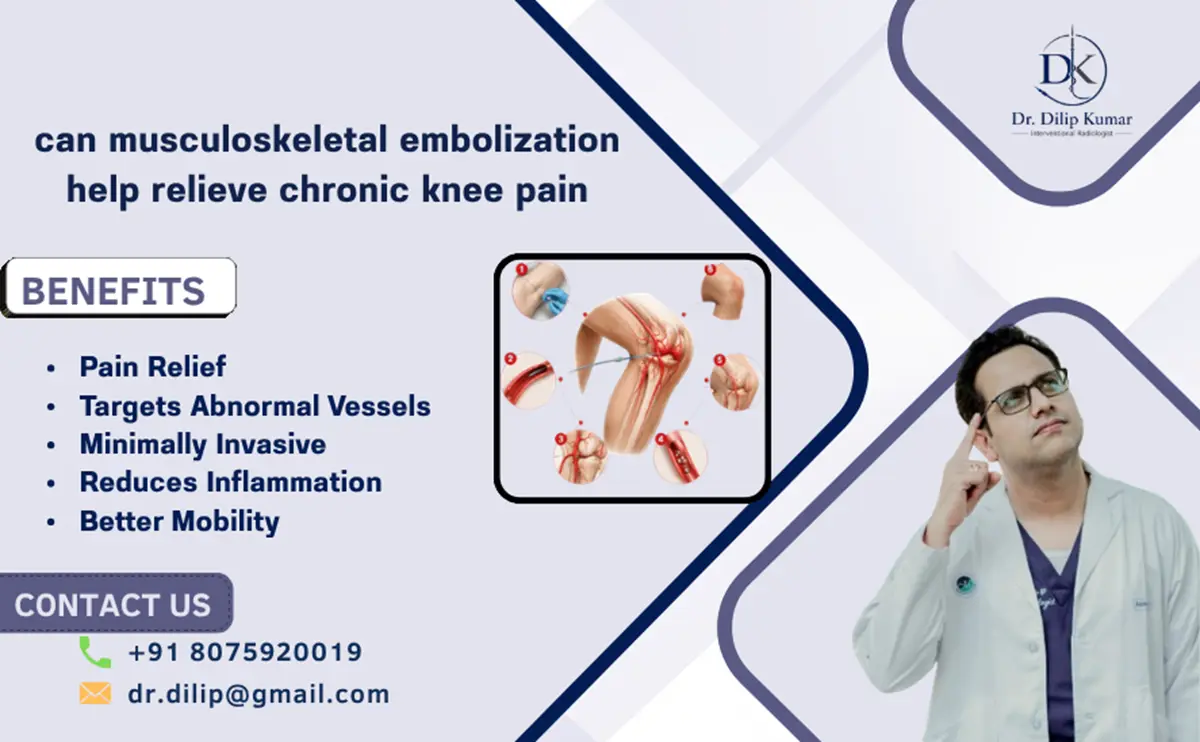
Chronic knee pain can affect walking, climbing stairs, exercising, working, and everyday activities. Knee osteoarthritis is one of the common causes of persistent knee pain, particularly as cartilage changes, inflammation, and other joint changes develop over time. Treatment usually begins with conservative measures such as exercise, weight management, physiotherapy, medicines, and selected injections. For some patients whose symptoms continue despite these approaches, minimally invasive interventional procedures may be considered.
Musculoskeletal Embolization for Chronic Knee Pain refers to an image-guided embolization technique, commonly known as genicular artery embolization (GA E), that targets abnormal blood vessels around the knee. The technique is designed to reduce abnormal vascularity associated with inflammation and pain. Recent research has reported encouraging improvements in pain and function, although randomized sham-controlled studies have produced mixed results, so it should not be presented as a guaranteed or universally established treatment.
For appropriately selected patients, an interventional radiologist can evaluate whether this approach may be suitable after reviewing symptoms, imaging and previous treatments. Dr Dilip Kumar, Interventional Radiologist in Kannur, provides image-guided minimally invasive procedures and can assess patients with chronic knee pain for appropriate interventional treatment options.
Chronic Knee Pain: Symptoms, Causes and Diagnosis
Common symptoms of chronic knee pain
Chronic knee pain can develop gradually or continue following an injury. Symptoms may vary depending on the underlying cause and severity.
Common symptoms include:
- Persistent knee pain during walking or standing
- Pain while climbing or descending stairs
- Knee stiffness, especially after periods of inactivity
- Swelling around the knee
- Reduced range of motion
- Difficulty walking for long periods
- Pain during physical activity
- Tenderness around the joint
- Clicking or grinding sensations
- Reduced ability to perform normal activities
Pain may be intermittent initially but can become more persistent as the underlying condition progresses.
Common causes
Osteoarthritis is a major cause of chronic knee pain. Other possible causes include previous knee injury, inflammatory joint conditions, meniscal problems, tendon disorders and recurrent bleeding into the joint.
In knee osteoarthritis, pain is not caused solely by cartilage loss. Inflammation of the synovial lining and changes in the small blood vessels around the joint may also contribute to pain. GAE is designed around this vascular and inflammatory component of the condition.
How is chronic knee pain diagnosed?
A proper diagnosis is important before selecting any treatment. Evaluation may include:
- Medical history
- Physical examination
- Assessment of walking and joint movement
- Knee X-rays
- Ultrasound in selected cases
- MRI when additional soft-tissue information is required
- Blood tests when an inflammatory or systemic condition is suspected
Recent expert consensus recommendations for GAE emphasize clinical examination and knee radiographs before treatment, with contrast-enhanced MRI considered in selected patients for additional assessment.
A diagnosis also helps determine whether the pain is actually coming from osteoarthritis or another condition that requires a different treatment.
Musculoskeletal Embolization for Chronic Knee Pain should therefore be considered only after appropriate clinical assessment rather than simply on the basis of knee pain alone.
How Musculoskeletal Embolization Works
What is musculoskeletal embolization?
Musculoskeletal embolization is an interventional radiology technique in which a thin catheter is used to access selected blood vessels supplying the painful area. In knee osteoarthritis, the procedure is generally referred to as genicular artery embolization.
The goal is to selectively reduce abnormal blood flow associated with hypervascularity around the knee. The technique is intended to address part of the inflammatory and vascular mechanism associated with pain.
How is the procedure performed?
The procedure generally follows several steps:
- Patient evaluation: The doctor reviews symptoms, imaging and previous treatments.
- Vascular access: A small catheter is introduced through an appropriate artery.
- Image guidance: Fluoroscopy and angiography help the interventional radiologist visualize the blood vessels.
- Identification of abnormal vessels: Vessels showing abnormal vascularity around the knee may be identified.
- Selective embolization: Small embolic material is delivered through the catheter to selected target vessels.
- Completion assessment: Angiography is performed to confirm the intended vascular effect.
- Recovery: The catheter is removed and the access site is monitored.
The exact technique, vessels treated and embolic material depend on the patient’s anatomy and clinical findings. Expert recommendations emphasize individualized patient selection and treatment.
Can it provide knee pain relief?
Research published in 2026 includes a systematic review of 18 studies involving 534 patients that reported meaningful improvements in pain and function after GAE. However, the authors also noted substantial variation between studies and stated that the magnitude of benefit remains uncertain because of differences in techniques, patient selection and recent sham-controlled findings.
Other recent evidence has been mixed. Some randomized studies have reported improved pain and function, while other sham-controlled research has not demonstrated a significant difference between GAE and sham treatment.
Therefore, Musculoskeletal Embolization for Chronic Knee Pain may be an option for selected patients, but outcomes can vary and the procedure should be discussed with an experienced interventional radiologist.
Potential benefits
When clinically appropriate, possible advantages include:
- Minimally invasive treatment
- No large surgical incision
- Image-guided targeting
- Potential reduction in chronic knee pain
- Potential improvement in physical function
- Joint-preserving approach
- May be considered when conservative treatment has not provided sufficient relief
The procedure does not regenerate damaged cartilage or reverse advanced osteoarthritis. Its primary purpose is symptom management, and patient selection is important.
Risks and limitations
Like any medical procedure, embolization has potential risks. These may include temporary pain flare, bruising, bleeding at the access site, infection, vascular injury or skin changes caused by unintended blood-vessel embolization. Recent reviews report that most complications have been minor and self-limiting, but larger studies are still needed to establish long-term safety and effectiveness more clearly.
Recovery, Comparison and Treatment Options
Recovery after the procedure
Recovery varies between patients. The access site may remain mildly sore or bruised for a short period. Some patients may experience temporary worsening of knee pain after embolization before improvement occurs. A 2026 prospective study reported transient pain exacerbation in approximately one-quarter of treated knees.
Your doctor may recommend:
- Keeping the access site clean and protected
- Limiting strenuous activity temporarily
- Taking prescribed medicines as directed
- Gradually returning to normal activity
- Continuing appropriate physiotherapy or exercise
- Attending scheduled follow-up appointments
The recovery plan should be individualized according to the procedure and the patient’s health.
Musculoskeletal embolization vs conventional treatment
| Treatment approach | Main purpose |
| Exercise & physiotherapy | Improve strength, mobility and function |
| Weight management | Reduce mechanical stress on the knee |
| Medicines | Manage pain and inflammation |
| Injections | Provide selected patients with symptom relief |
| Musculoskeletal/Genicular Artery Embolization | Target abnormal periarticular vascularity in selected patients |
| Knee replacement | Surgically replace severely damaged joint surfaces |
These treatments are not direct substitutes for one another. A patient’s age, symptoms, imaging findings, activity level, severity of osteoarthritis and response to previous treatment all influence the appropriate management strategy.
Who may be considered for the procedure?
Recent expert consensus has considered GAE for patients with persistent knee pain related to conditions such as osteoarthritis, tendinopathies or previous knee surgery after conservative treatment has failed for an appropriate period. However, eligibility must be determined individually.
Patients with advanced structural damage, vascular problems or other medical conditions may require a different treatment strategy.
Musculoskeletal Embolization for Chronic Knee Pain is therefore best considered as part of a personalized treatment plan rather than a replacement for exercise, physiotherapy or other evidence-based knee care.
Services by Dr Dilip Kumar in Kannur
Dr Dilip Kumar, Interventional Radiologist in Kannur, provides minimally invasive, image-guided treatment options for selected vascular and musculoskeletal conditions.
Services may include:
- Musculoskeletal Embolization
- Genicular Artery Embolization
- Knee pain interventions
- Peripheral vascular interventions
- Peripheral artery disease procedures
- Image-guided embolization procedures
- Other interventional radiology procedures based on individual diagnosis
A consultation can help determine whether an interventional procedure is appropriate or whether another treatment should be considered.
Frequently Asked Questions
1. Can musculoskeletal embolization help chronic knee pain?
It may provide pain relief for selected patients, particularly those with persistent symptoms associated with knee osteoarthritis. However, current research has produced mixed results, and it is not effective for everyone.
2. Is musculoskeletal embolization the same as genicular artery embolization?
In the context of chronic knee pain, musculoskeletal embolization commonly refers to embolization of selected genicular arteries. GAE is the more specific term used for this knee procedure.
3. Is it a surgical procedure?
No. It is a minimally invasive catheter-based procedure performed under imaging guidance rather than open knee surgery.
4. Does the procedure replace knee replacement?
Not necessarily. GAE is a different treatment approach and does not replace a knee joint. Whether it is appropriate depends on the severity of joint damage and the individual patient’s circumstances.
5. How long does recovery take?
Recovery varies. Many patients can resume routine activities relatively quickly, but the treating doctor will provide specific instructions based on the procedure and overall health.
6. Can it treat knee osteoarthritis?
GAE is being studied and used for selected patients with symptomatic knee osteoarthritis. Current evidence suggests potential symptom improvement, but research remains evolving and results across controlled trials are not consistent.
7. Is the procedure painful?
The procedure is performed with appropriate local anesthesia and/or sedation according to the clinical setting. Temporary discomfort or a short-term pain flare can occur after treatment.
8. Is everyone with knee pain suitable for embolization?
No. A detailed clinical evaluation is required. The underlying cause of pain, imaging findings, previous treatments and vascular anatomy all need to be considered.
9. When should I consult an interventional radiologist?
Consider discussing an interventional option when chronic knee pain continues despite appropriate conservative treatment and your doctor believes an image-guided intervention may be suitable.
Conclusion
Chronic knee pain can significantly interfere with mobility and quality of life. While physiotherapy, exercise, weight management, medication and other conservative approaches remain important, minimally invasive interventional procedures are being investigated and used for selected patients who continue to experience symptoms.
Musculoskeletal Embolization for Chronic Knee Pain is an emerging approach that targets abnormal vascularity around the knee. Current research shows promising pain and functional improvements in several studies, but evidence from randomized sham-controlled trials remains mixed.
For this reason, treatment should be based on a proper diagnosis and individualized assessment rather than assuming embolization is suitable for every patient.
Dr Dilip Kumar, Interventional Radiologist in Kannur, can evaluate chronic knee pain and discuss appropriate image-guided treatment options, including musculoskeletal embolization and other interventional procedures where clinically indicated.
If chronic knee pain is affecting your daily activities despite conservative treatment, book a consultation with Dr Dilip Kumar in Kannur to discuss your diagnosis and suitable minimally invasive treatment options.