

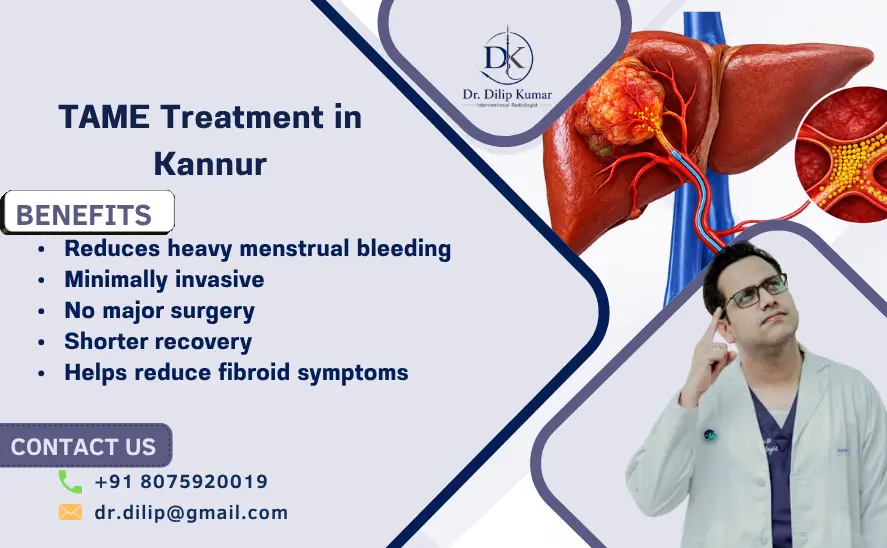
TAME Treatment in Kannur is a minimally invasive interventional radiology technique that may be used to treat selected tumors by delivering microwave energy through a specially positioned probe. TAME refers to Transarterial Microwave Ablation, an approach that combines arterial access with microwave-based tumor ablation. It is designed to target abnormal tissue while limiting damage to surrounding healthy tissue.
Unlike conventional open surgery, transarterial procedures are performed through a blood vessel, commonly using a catheter introduced through a small puncture. The exact technique and suitability depend on the tumor’s location, size, blood supply, underlying medical conditions, and imaging findings.
TAME Treatment in Kannur may be considered in carefully selected patients when a minimally invasive local treatment is appropriate. An interventional radiologist evaluates imaging and clinical history before recommending the procedure.
For patients searching for TAME Treatment in Kannur, Dr. Dilip Kumar, an experienced Interventional Radiologist in Kannur, Kerala, provides image-guided minimally invasive treatment options for selected vascular and tumor-related conditions.
What Is TAME Treatment and When Is It Recommended?
TAME Treatment in Kannur uses catheter-based arterial access to reach the blood vessels supplying a target lesion, followed by microwave energy to generate heat and destroy targeted abnormal tissue. The procedure is performed under image guidance so that the treatment can be planned and delivered as accurately as possible.
How Transarterial Microwave Ablation Works
Transarterial Microwave Ablation uses electromagnetic energy to create controlled thermal destruction of abnormal tissue. Depending on the individual case, the interventional radiologist may:
- Review CT, MRI, ultrasound, angiography, and laboratory findings.
- Identify the blood vessels supplying the target lesion.
- Introduce a thin catheter through a small vascular access point.
- Navigate the catheter toward the relevant arterial branch.
- Position the treatment system according to the planned approach.
- Deliver microwave energy to heat and ablate the targeted tissue.
- Use imaging to assess treatment coverage and immediate results.
The procedure is individualized rather than being a single standardized treatment for every patient.
Conditions That May Be Considered
Depending on the clinical situation, transarterial ablation techniques may be evaluated for selected tumors, particularly when conventional treatment is difficult or when local tumor control is required.
Patients may be referred for evaluation because of:
- A diagnosed liver tumor
- A localized tumor requiring image-guided treatment
- A tumor that is difficult to access surgically
- Medical conditions that make major surgery less suitable
- Recurrent or residual tumor after previous treatment
It is important to understand that TAME Treatment in Kannur is not automatically suitable for every tumor. A multidisciplinary assessment may be required before treatment.
Symptoms That May Require Evaluation
The symptoms depend mainly on the underlying disease rather than the TAME procedure itself. Depending on the tumor and its location, patients may experience:
- Persistent abdominal discomfort
- Unexplained weight loss
- Reduced appetite
- Fatigue or weakness
- Abdominal fullness
- Jaundice in certain liver-related conditions
- Abnormal liver-function tests
- A mass detected during imaging
Some tumors cause no symptoms and are discovered incidentally during ultrasound, CT, or MRI.
Diagnosis and Treatment Procedure
Before TAME Treatment in Kannur, detailed evaluation is essential. The objective is to determine whether the lesion can be treated safely and whether transarterial ablation is an appropriate treatment option.
Diagnosis and Pre-Procedure Evaluation
The doctor may recommend:
- Medical history and physical examination
- Blood investigations
- Liver-function tests when relevant
- Tumor-marker testing when clinically indicated
- Ultrasound
- Contrast-enhanced CT
- MRI
- CT or MR angiography
- Diagnostic angiography in selected cases
- Biopsy when required for diagnosis
Imaging helps determine the tumor’s size, location, vascular anatomy, relationship with nearby organs, and potential treatment route.
TAME Treatment Procedure
The procedure is generally performed in a specialized interventional radiology suite under sterile conditions.
Local anesthesia and, when appropriate, sedation are used to improve patient comfort. A small puncture is made to access a blood vessel, and a catheter is guided under imaging toward the artery supplying the target lesion.
Once the target anatomy is confirmed, the planned microwave ablation is performed. The energy produces heat within the treatment zone, causing thermal injury to the targeted abnormal tissue.
The treatment duration varies according to the lesion, vascular anatomy, treatment plan, and individual patient factors.
Benefits of TAME Treatment
Potential advantages of a transarterial microwave-based approach may include:
- Minimally invasive vascular access
- Smaller access site compared with open surgery
- Image-guided treatment
- Targeted treatment of selected lesions
- Potentially shorter recovery than major surgery
- Reduced disruption of surrounding tissues in appropriately selected cases
- Possibility of treatment when surgery is technically difficult or unsuitable
However, benefits vary between patients. The procedure should be recommended only after assessing expected benefits against potential risks.
Risks and Limitations
Although minimally invasive, TAME is still a medical procedure and can have complications. Possible risks may include bleeding or bruising at the access site, infection, vascular injury, contrast-related reactions, damage to nearby structures, post-procedure pain or fever, and incomplete tumor treatment.
The risks depend on the tumor location, patient’s overall health, vascular anatomy, and treatment strategy. Your interventional radiologist will explain the expected benefits and risks before the procedure.
Recovery, Aftercare and Comparison With Other Treatments
Recovery following TAME Treatment in Kannur depends on the type and extent of treatment, the underlying condition, and the patient’s overall health.
Recovery After the Procedure
Patients are usually monitored after treatment for vital signs, pain, bleeding, and other immediate complications. Some patients may be discharged after observation, while others may require hospital monitoring.
During recovery, patients may be advised to:
- Keep the vascular access area clean and protected
- Avoid strenuous activity for the period recommended by the treating team
- Take prescribed medications as directed
- Attend scheduled follow-up appointments
- Report persistent fever, severe pain, bleeding, swelling, or other concerning symptoms promptly
Follow-up imaging may be performed to determine treatment response and monitor the treated lesion.
TAME vs Conventional Surgery
Traditional surgery physically removes a tumor or affected portion of an organ. In contrast, a transarterial microwave approach is designed to treat selected abnormal tissue using catheter-based vascular access and thermal energy.
Surgery may remain the preferred treatment for some patients because it can provide definitive removal of a lesion. TAME may be considered when a minimally invasive local treatment is appropriate.
The choice should therefore be based on tumor characteristics, patient health, treatment goals, and multidisciplinary medical assessment—not simply on the fact that one procedure is less invasive.
TAME vs Other Ablation Techniques
Microwave ablation is one form of thermal ablation. Other techniques include radiofrequency ablation and, in selected circumstances, cryoablation.
Each method has different technical characteristics and applications. The most appropriate technique depends on factors such as tumor size, location, blood supply, proximity to critical structures, and previous treatments.
FAQs About TAME Treatment in Kannur
1. What is TAME Treatment?
TAME stands for Transarterial Microwave Ablation. It is an image-guided minimally invasive technique that uses arterial access and microwave energy to treat selected abnormal or tumor tissue.
2. Who may be suitable for TAME Treatment?
Suitability depends on the type, size, location, and blood supply of the lesion, as well as the patient’s general health. Imaging and clinical evaluation are necessary before treatment.
3. Is TAME a surgical procedure?
TAME is generally considered a minimally invasive interventional radiology procedure rather than conventional open surgery. It uses catheter-based vascular access and image guidance.
4. Is TAME Treatment Painful?
The procedure is performed using local anesthesia, with sedation used when appropriate. Some discomfort, pain, or fever can occur after ablation, but the treating team provides appropriate pain management.
5. How long does recovery take?
Recovery varies depending on the procedure and the patient’s medical condition. Many minimally invasive procedures allow earlier recovery than major surgery, but individual recovery times differ.
6. Is TAME suitable for liver tumors?
Transarterial and ablation-based approaches may be considered for selected liver tumors. Whether TAME is appropriate depends on the tumor’s characteristics and the patient’s overall clinical condition.
7. What tests are required before TAME?
Depending on the case, doctors may request blood tests, liver-function tests, ultrasound, contrast CT, MRI, angiographic imaging, and occasionally biopsy.
8. Can TAME completely destroy a tumor?
The goal of ablation is to destroy the targeted treatment zone, but treatment effectiveness depends on tumor characteristics and whether adequate treatment coverage is achieved. Follow-up imaging is important.
9. How is TAME different from chemotherapy?
TAME is a local, image-guided interventional treatment, whereas chemotherapy uses anticancer medicines that can act systemically or through specific treatment routes. They are fundamentally different therapies and may sometimes be considered as part of a broader treatment plan.
10. Where can I get TAME Treatment in Kannur?
Patients can consult Dr. Dilip Kumar, Interventional Radiologist in Kannur, Kerala, for assessment of whether a minimally invasive treatment such as TAME is appropriate for their condition.
Conclusion
TAME Treatment in Kannur represents an advanced minimally invasive approach that combines interventional radiology with microwave ablation for carefully selected lesions. By using image guidance and catheter-based access, the treatment can target abnormal tissue while potentially avoiding the larger incisions associated with conventional surgery.
However, TAME is not a one-size-fits-all treatment. Accurate diagnosis, detailed imaging, assessment of vascular anatomy, and evaluation by an experienced interventional radiologist are essential before deciding on treatment.
If you have been diagnosed with a tumor or are looking for minimally invasive treatment options, discuss your imaging reports and medical history with an experienced specialist.
Book Your Consultation With Dr. Dilip Kumar
Looking for TAME Treatment in Kannur? Consult Dr. Dilip Kumar | Best Interventional Radiologist in Kannur, Kerala for expert evaluation and image-guided minimally invasive treatment options.
Book an appointment today to discuss your diagnosis, treatment options, expected benefits, risks, and recovery plan with Dr. Dilip Kumar.