

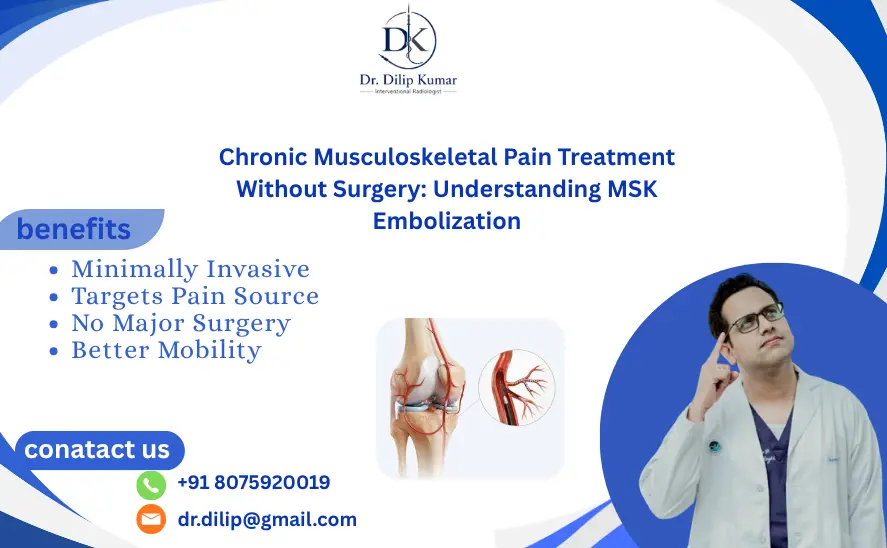
Chronic musculoskeletal pain can affect the joints, muscles, tendons, and surrounding tissues, making everyday activities such as walking, climbing stairs, or exercising difficult. While medication, physiotherapy, and lifestyle changes help many patients, some continue to experience pain despite conservative treatment.
MSK embolization is a minimally invasive, image-guided procedure that aims to reduce pain in selected patients by blocking abnormal blood vessels associated with chronic inflammation. It may be considered for certain musculoskeletal conditions when conventional treatments have not provided adequate relief.
For patients exploring Non-Surgical Pain Treatment in Kannur, understanding the causes of persistent pain, available treatment options, and the role of interventional radiology can help them make informed decisions.
Dr. Dilip Kumar, an interventional radiologist, can assess whether an image-guided intervention is appropriate based on the patient’s diagnosis, imaging findings, medical history, and previous treatment response.
What Is Chronic Musculoskeletal Pain?
Chronic musculoskeletal pain is pain affecting the bones, joints, muscles, tendons, ligaments, or related soft tissues that persists or recurs over an extended period. It may develop gradually due to degenerative changes or continue after an injury has healed.
Chronic Musculoskeletal Pain Treatment Without Surgery: Understanding MSK Embolization introduces an option that may help carefully selected patients manage persistent pain without undergoing an open surgical procedure.
Common symptoms of musculoskeletal pain
Symptoms vary according to the affected area and the underlying condition. Common signs include:
- Persistent knee, hip, shoulder, or other joint pain.
- Swelling, tenderness, or stiffness around a joint.
- Pain during movement or after physical activity.
- Reduced range of motion.
- Difficulty walking, climbing stairs, or standing for long periods.
- Discomfort that interferes with sleep or everyday activities.
Pain that persists despite appropriate treatment warrants a medical assessment. Sudden severe pain, a hot and swollen joint with fever, or an inability to bear weight may require urgent evaluation.
What causes chronic musculoskeletal pain?
Several conditions can contribute to persistent pain:
- Osteoarthritis: Progressive changes in the joint can cause pain, stiffness, and reduced mobility.
- Tendinopathy: Repetitive strain or degeneration can affect tendons around the joints.
- Bursitis: Inflammation of small fluid-filled sacs near joints may cause tenderness and movement-related pain.
- Sports injuries: Damage to tendons, ligaments, or other soft tissues can lead to ongoing symptoms.
- Inflammatory joint conditions: Disorders such as rheumatoid arthritis may cause pain and swelling.
- Persistent post-injury pain: Symptoms can continue even after the initial injury has healed.
In some chronic inflammatory conditions, abnormal small blood vessels may develop around the affected tissues. These vessels can be associated with persistent inflammation and pain. MSK embolization aims to target selected abnormal vessels rather than treating every cause of musculoskeletal pain.
How Is MSK Embolization Diagnosed and Performed?
Diagnosis before treatment
Before recommending musculoskeletal pain treatment without surgery, a specialist must establish the cause of the pain and determine whether embolization is likely to help.
The assessment may include:
- Medical history: The doctor reviews symptom duration, previous injuries, existing conditions, and treatments already attempted.
- Physical examination: The affected joint or tissue is examined for tenderness, swelling, stability, and movement limitations.
- Imaging: X-rays, ultrasound, or MRI may help identify arthritis, tendon abnormalities, and other potential causes.
- Review of previous treatment: Medication, physiotherapy, injections, and their effectiveness are considered.
- Assessment of suitability: The specialist determines whether the symptoms and imaging findings support consideration of embolization.
Not every patient with chronic pain has abnormal vessels suitable for embolization. Other conditions, such as advanced joint degeneration, infection, or a mechanical problem, may require different treatment.
How does MSK embolization work?
MSK embolization is performed by a trained interventional radiologist using imaging guidance. The procedure is intended to reduce blood flow through selected abnormal vessels associated with chronic inflammation.
Although the exact approach depends on the affected area, the procedure generally involves the following steps.
Step 1: Preparation
The doctor reviews relevant investigations, medications, allergies, and overall health. The patient receives instructions regarding eating, drinking, and medication adjustments when necessary.
Step 2: Access to a blood vessel
After local anaesthesia, a small catheter is introduced through a blood vessel, commonly in the wrist or groin, depending on the treatment plan.
Step 3: Image-guided navigation
Using angiographic imaging, the interventional radiologist guides the catheter towards the vessels supplying the targeted area.
Step 4: Embolization
A suitable embolic material is delivered to selected abnormal vessels to reduce their blood flow. The aim is to target the intended vessels while preserving normal circulation to surrounding tissues.
Step 5: Completion and observation
The catheter is removed, the access site is treated, and the patient is monitored before discharge or further observation as appropriate.
MSK embolization is not the same as joint replacement, arthroscopy, or an ordinary pain-relief injection. It targets the blood supply to selected abnormal vessels rather than directly repairing cartilage or reconstructing a joint.
Benefits, Recovery and Comparison With Other Treatments
Potential benefits of MSK embolization
For appropriately selected patients, possible benefits include:
- A minimally invasive approach using a small vascular access site.
- No need for an open surgical incision at the affected joint.
- The potential to reduce chronic pain and improve movement.
- A possible alternative when conservative measures have not provided sufficient relief.
- A generally shorter initial recovery than many major surgical procedures.
Important: Outcomes vary. Pain relief is not guaranteed, and the evidence supporting MSK embolization differs by condition. The procedure may not be suitable for every patient, particularly when pain results primarily from advanced structural joint damage.
Recovery after MSK embolization
Recovery depends on the treated area, the patient’s health, and the details of the procedure.
Many patients are observed for several hours and may return home on the same day, depending on clinical circumstances. Mild discomfort, bruising, or tenderness at the catheter entry site can occur.
During recovery, patients should:
- Follow the treating specialist’s instructions about activity and wound care.
- Avoid strenuous activity for the recommended period.
- Take prescribed medication as directed.
- Attend follow-up appointments to assess pain, mobility, and treatment response.
- Seek medical attention for increasing pain, significant swelling, fever, unusual changes in limb colour or temperature, or other concerning symptoms.
Improvements may develop gradually rather than immediately. Some patients need ongoing physiotherapy or other supportive care to improve strength and function.
MSK embolization compared with other treatments
| Treatment | Main purpose | Important consideration |
| Medication | Relieve pain or manage inflammation | Benefits and side effects depend on the medicine |
| Physiotherapy | Improve strength, movement, and function | Requires an individualised programme |
| Joint injections | Deliver medication into or around an affected joint | Relief varies by condition and injection type |
| MSK embolization | Reduce blood flow to selected abnormal vessels | Suitable only for selected conditions and patients |
| Surgery | Address structural damage or advanced disease | Recovery and risks depend on the operation |
The appropriate choice depends on the diagnosis, severity of symptoms, imaging results, previous treatment, and patient preferences. MSK embolization should not automatically replace established treatments such as physiotherapy or surgery when those options are indicated.
Who may be suitable for MSK embolization?
A patient may be considered for assessment if they have persistent musculoskeletal pain, a confirmed underlying diagnosis, and inadequate improvement with appropriate conservative treatment.
Suitability also depends on whether the affected tissue has a pattern that can reasonably be targeted through embolization. The doctor must assess potential benefits against procedural risks, including bleeding, infection, damage to surrounding tissues, and unintended reduction in blood supply.
MSK embolization in Kannur
Patients seeking Non-Surgical Pain Treatment near me in Kannur can consult an appropriately qualified specialist to discuss the cause of their symptoms and available options.
Dr. Dilip Kumar, an interventional radiologist, can be contacted to enquire about evaluation for image-guided pain procedures. A consultation should establish whether MSK embolization is appropriate or whether another treatment would be more effective.
Location: Chala, Keralam 670621.
Treatment costs depend on the condition being treated, investigations required, procedural complexity, hospital facilities, and follow-up needs. A reliable estimate should be provided by the treating centre after individual assessment rather than assuming a standard price.
Frequently Asked Questions About MSK Embolization
1. What is MSK embolization?
MSK embolization is a minimally invasive procedure that uses imaging guidance to block selected abnormal blood vessels associated with chronic musculoskeletal pain. It may be considered for certain conditions after specialist assessment.
2. Is MSK embolization a type of non-surgical pain treatment?
Yes. It is performed through a small vascular access site rather than an open surgical incision. However, it is still an invasive medical procedure with potential risks and is not suitable for every cause of pain.
3. Which conditions can MSK embolization treat?
It has been investigated and used for selected conditions, including certain cases of knee osteoarthritis-related pain and tendinopathy. The strength of evidence and suitability vary by condition, and not every patient will benefit.
4. Is MSK embolization painful?
Local anaesthesia is generally used at the catheter entry site. Patients may experience temporary discomfort during or after the procedure, but the experience varies depending on the treated area and individual circumstances.
5. How long does recovery take?
Recovery varies. Some patients return to light daily activities relatively soon, while others need more time and follow-up. The treating specialist will provide specific activity restrictions and recovery guidance.
6. Does MSK embolization provide permanent pain relief?
Permanent relief cannot be guaranteed. Some patients experience meaningful improvement, while others have partial or limited benefit. The underlying condition may continue to progress, and further treatment may be needed.
7. Is MSK embolization better than surgery?
Neither treatment is universally better. Embolization may be an option for selected patients who want to explore a minimally invasive approach, whereas surgery may be more appropriate for advanced structural damage or other specific diagnoses.
8. What tests are needed before MSK embolization?
Depending on the condition, the assessment may include a physical examination, X-rays, ultrasound, MRI, blood tests, and a review of previous treatments. The specialist determines which investigations are necessary.
9. How can I inquire about the MSK embolization in Kannur?
Contact Dr. Dilip Kumar’s clinic or treating centre to ask about an appointment, assessment requirements, and the availability of MSK embolization. The consultation will help determine whether the procedure is suitable for your condition.
Conclusion: Explore Suitable Options for Chronic Musculoskeletal Pain
Chronic Musculoskeletal Pain Treatment Without Surgery: Understanding MSK Embolization explains how an image-guided procedure may offer another option for selected patients with persistent musculoskeletal pain.
MSK embolization aims to reduce blood flow to abnormal vessels associated with chronic inflammation. It may help some patients improve pain and mobility, but its effectiveness depends on the underlying condition, and it is not a replacement for every established treatment.
A careful diagnosis and individual assessment are essential before deciding on a procedure.
Book an Appointment With Dr. Dilip Kumar
If chronic joint or musculoskeletal pain continues to affect your daily activities, arrange a consultation to discuss your symptoms, previous treatments, and whether an interventional radiology procedure may be appropriate.
Dr. Dilip Kumar — Interventional Radiologist
- Phone: +918075920019
- Location: Chala, Keralam 670621